What Burnout Is Really Doing to Our Educators — and Our Students
By Courtney Orange — Resilience Speaker, Human Capital Consultant & Programme Designer
The Numbers Should Alarm Every CEO, Headmaster and Trust Leader
Before the anecdotes, before the staffroom stories — start with the data, because it is genuinely disturbing.
In 2025, 86% of school leaders reported experiencing workplace stress — the highest figure ever recorded, up from 84% the year before. Among the wider teaching workforce, 76% reported workplace stress, and wellbeing scores measured on the clinically validated Warwick-Edinburgh Mental Wellbeing Scale hit their lowest point since tracking began in 2019. Nearly half of education staff — 49% — say their own organisation’s culture is actively harming their mental health.
It gets worse. 61% of UK teaching staff say they do not plan to stay in the profession long term, and over half of those expect to leave within five years. This is not a slow leak. It is a structural failure of workforce sustainability happening in real time, inside institutions that are simultaneously being asked to raise attainment, widen inclusion, and deliver “outstanding” pastoral care.
And critically — this is not simply a staff welfare issue. Peer-reviewed research analysing more than 50,000 students taught by over 5,000 teachers found that teacher burnout is measurably associated with worse academic achievement and lower quality student motivation, particularly in reading and mathematics outcomes. When the adult in the room is exhausted, the child in the room learns less. Burnout doesn’t stay contained in the staffroom — it walks straight into the classroom, the boarding house, the lecture theatre, and the pastoral office.
Why Educators Burn Out Like Elite Athletes — But Without the Recovery Protocols
Having worked inside more than 400 schools, colleges, multi-academy trusts, independent schools, international school groups and universities — as a resilience speaker, senior leadership consultant and “fly on the wall” in staffrooms, CPD days and SLT briefings — I have observed the same pattern repeat itself across every sector, region and pay grade.
The chart below is drawn from that fieldwork, comparing the physical, emotional and cognitive energy demand placed on three groups: teachers, elite athletes and general professionals, scored 1–10.
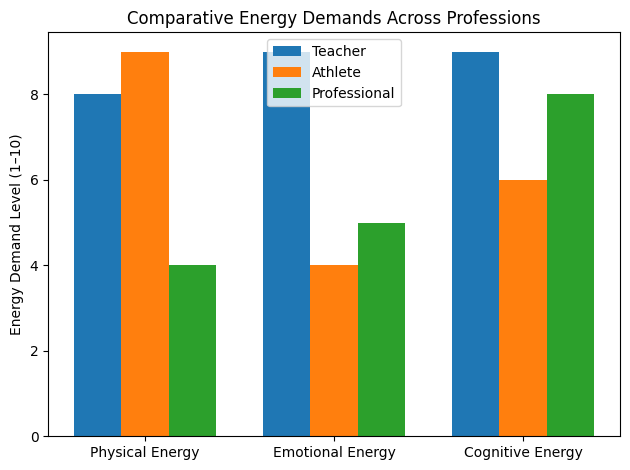
The pattern is striking. Teachers sit at or near the top of every single category — 8/10 physical energy, 9/10 emotional energy, 9/10 cognitive energy. An elite athlete matches or exceeds them on physical output, but critically, athletes operate within a performance ecosystem built entirely around recovery: periodised training, mandated rest days, sports psychologists, nutritionists and physiotherapists on staff. The general professional, by contrast, faces meaningfully lower demand across the board.
Educators are being asked to sustain elite-athlete-level output across all three energy systems simultaneously, for 39+ weeks a year, with almost none of the recovery infrastructure that protects an athlete from breakdown. That is the core insight behind The Corporate Apparatus™ framework — and it is why burnout in education is not a personal resilience failure. It is a systems design failure.
What Burnout Actually Does — At Every Level of the Organisation

- The classroom teacher: chronic exhaustion, insomnia (reported by 46% of staff) and irritability (44%) erode patience, creativity and the individualised attention students need most.
- Middle leadership: caught between delivering trust or SLT mandates and shielding their teams, middle leaders absorb stress from both directions with the least authority to change either.
- Senior leadership and headteachers: consistently the most affected group in every national wellbeing survey — carrying accountability, safeguarding, staffing and financial pressure with nowhere to offload it.
- Students and pupils: lower academic achievement, reduced literacy growth, and diminished motivation — the downstream cost of an under-resourced adult trying to hold an emotionally demanding room together.
This is why staff wellbeing, presenteeism and student outcomes cannot be treated as three separate agenda items. They are one and the same conversation.
Seven Non-Negotiables for Senior Leadership Teams
Reducing teacher burnout and staff turnover requires more than a wellbeing day or a mindfulness app subscription. Based on programme design and delivery work with trusts, independent schools, universities and unions, here are seven non-negotiables:
- Audit emotional labour, not just workload hours. Timetabled hours rarely capture pastoral, behavioural and parental-conflict labour — the true driver of exhaustion.
- Build recovery into the calendar, not around it. Protected non-contact recovery windows should be scheduled with the same rigour as an athlete’s rest day — not treated as optional.
- Train middle leaders in resilience-informed management, not just performance management — they are your highest-risk, highest-leverage layer.
- Separate presenteeism from performance. A visibly present but depleted staff member is not a productive one; measure output and wellbeing together.
- Create structured psychological safety for senior leaders themselves — headteachers and CEOs are the most burnt-out group of all, yet the least likely to have support built for them.
- Invest in CPD that builds capacity, not compliance. One-off INSET talks rarely shift culture; sustained, phased programmes do.
- Make wellbeing data a governance-level KPI, reviewed by the board or trust leadership alongside attainment and finance — not delegated solely to HR.
Institutions that act on these — whether state, independent, or multi-academy trust — see the return not just in staff retention, but in reduced presenteeism, stronger recruitment pipelines, and measurably better pupil outcomes.
Where This Goes From Here
As a professional wellbeing expert, resilience speaker and programme designer, and as a human capital consultant to the education sector, I’ve had the privilege of designing and delivering resilience, CPD and leadership wellbeing programmes with institutions including Exeter University, King’s College London, the Headmasters’ and Headmistresses’ Conference (HMC), the National Education Union, and Nord Anglia Education Group.
If your trust, school, college or university is planning ahead for the new academic year starting September 2026 and wants a bespoke resilience or staff wellbeing programme designed around your specific context, I’d welcome the conversation. Get in touch at info@courtneyorange.com.
You can also explore the framework behind this article — The Corporate Apparatus™ — and our full range of resilience and wellbeing programmes at courtneyorange.com.