Here Is What Every Operations Leader Must Understand
Large-scale manufacturing, textiles, and supply chain infrastructure across South Asia represent some of the most complex, fast-moving, and operationally demanding environments on the planet. Thousands of workers. Distributed sites. Razor-thin margins. And middle managers expected to absorb every disruption — from raw material shortages to sudden regulatory shifts to global demand fluctuations — without allowing a single moment of that turbulence to halt the line.
If your organisation is searching for a resilience speaker, a targeted resilience workshop, or a structured resilience programme built for the realities of industrial operations, this article will show you why the pressure sitting on your middle management layer is one of the most underestimated risks in your entire operation — and what it takes to address it properly.
The Breaking Point Nobody Talks About on the Factory Floor
Ask any operations director in manufacturing or supply chain what keeps them awake at night and you will hear about logistics delays, input costs, and output targets. What you will rarely hear about — but what is quietly eroding the performance of organisations across South Asia — is the psychological state of the people responsible for translating those pressures into daily operational reality.
Middle managers in manufacturing environments occupy one of the most psychologically demanding positions in any organisation. They are accountable upward for targets they do not always control. They are responsible downward for a large, distributed labour force navigating its own pressures — shift fatigue, physical demand, and the anxiety of rapid operational change. And they are expected to pivot smoothly when supply chain disruptions arrive, as they now do with increasing frequency, without missing a beat and without letting uncertainty travel down to the people they lead.
This is not a logistics problem. This is a human capital resilience problem. And it requires a solution built specifically for the industrial environment — not a corporate wellness programme designed for an open-plan office.

Research by McKinsey into supply chain resilience identifies human adaptability at the middle management layer as one of the defining variables separating supply chains that recover quickly from disruption and those that stall. Meanwhile, the International Labour Organisation’s research on workplace wellbeing in manufacturing consistently highlights the compounding effect of unaddressed psychological pressure on both safety outcomes and operational productivity across industrial workforces.
What a Resilience Programme Looks Like for Manufacturing and Supply Chain Organisations
A resilience workshop for a manufacturing or supply chain environment is not a seminar in a conference room disconnected from operational reality. It is a precision intervention designed around the rhythms, pressures, and language of industrial operations — built to produce measurable behavioural change at the layer where it matters most.
Senior Operations Leadership — Equipping plant directors, supply chain heads, and operations executives with the strategic resilience frameworks needed to make clear, confident decisions during periods of rapid disruption. When leadership is visibly grounded during a crisis, that stability radiates outward. When it is not, uncertainty amplifies at every level below.
Middle Management & Shift Supervisors — This is where a resilience programme for manufacturing delivers its most significant return. This layer absorbs pressure from both directions simultaneously and is routinely the first to fracture when operational conditions deteriorate. Equipping site managers, shift supervisors, and department leads with practical tools for managing their own psychological state while guiding large teams through uncertainty is one of the highest-leverage investments any manufacturing organisation can make.
Frontline Team Leads & Workforce Representatives — Building basic resilience literacy at the frontline level reduces the frequency of reactive incidents, improves communication during operational pivots, and creates a more cohesive workforce culture that holds together under pressure rather than fragmenting into silos and grievance.
The goal is operational muscle memory — the ability of your management structure to absorb disruption, adapt fluidly, and maintain output continuity without the kind of human friction that slows everything down and costs far more than the disruption itself.
To explore how these frameworks are structured and delivered across industrial environments, visit Courtney Orange’s human capital resilience consulting practice for an overview of the programme models available.
Three Key Takeaways
1. Your supply chain is only as resilient as the people managing it. Organisations across South Asia invest heavily in supply chain technology, logistics infrastructure, and operational systems. Far fewer invest in the psychological readiness of the human beings responsible for operating those systems under pressure. When the next disruption arrives — and it will — the speed and quality of your recovery will be determined not by your software platform, but by the adaptability of your middle management layer.
2. Operational pivots fail at the human layer, not the logistics layer. When a supply chain pivot stalls, the instinct is to diagnose the problem as a logistics failure — a missed shipment, a vendor delay, a systems gap. In reality, the majority of operational pivot failures trace back to a breakdown in human communication, decision-making clarity, and psychological safety within the management structure. A resilience programme that strengthens these human capacities makes every future operational pivot faster, smoother, and less costly.
3. Middle manager attrition in manufacturing is a compounding crisis. When an experienced shift supervisor or site manager leaves a manufacturing operation, they take with them an intimate knowledge of the workforce, the machinery, the unofficial workflows, and the cultural rhythms of the site that cannot be found in any handover document. Protecting these individuals through genuine resilience investment is not a welfare gesture — it is an operational continuity strategy with a measurable bottom-line impact.
If your manufacturing, textiles, or supply chain organisation across South Asia is ready to move beyond reactive crisis management and build the kind of human infrastructure that keeps your operation moving when conditions are at their most demanding, the conversation starts here.
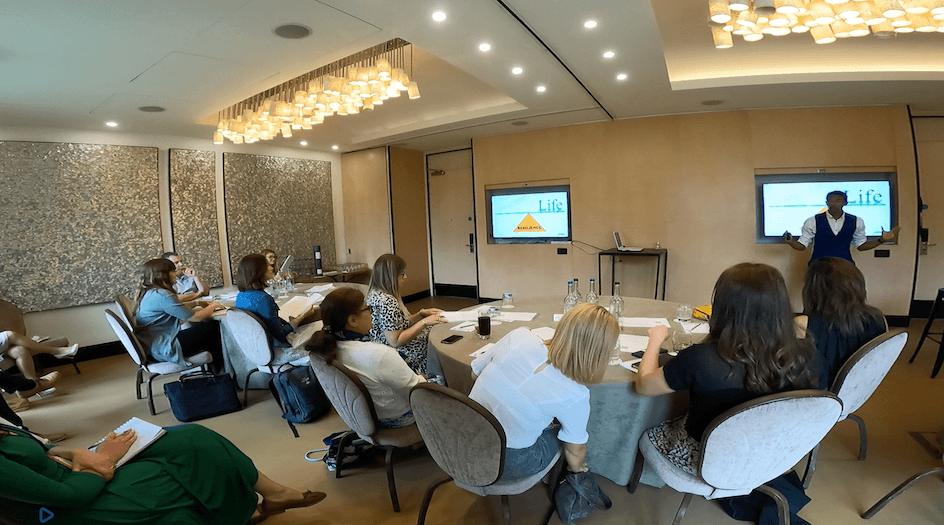
Reach out to Courtney Orange — resilience speaker, human capital consultant, and programme architect for industrial and supply chain environments — to explore how a bespoke resilience workshop or full programme can be designed around the specific pressures your operations and management teams are carrying right now.
Courtney Orange works with manufacturing organisations, textiles groups, and supply chain infrastructure leaders across South Asia and beyond, delivering resilience keynotes, management workshops, and multi-module consultancy programmes designed for the operational realities of large-scale industrial environments.
